in the last post about the conch i told you how amma blows up a small into something huge… here is another story.
this story actually began during covid.
amma encouraged everyone to learn tabla. brahmachari hari was instructed to teach.
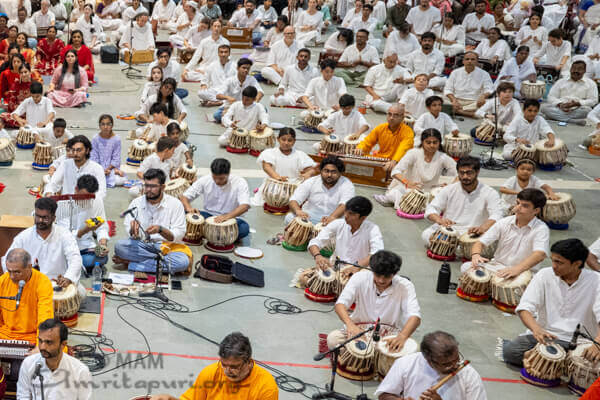
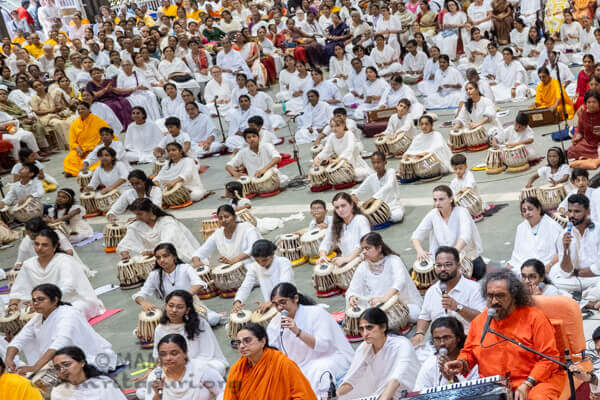
soon, around 400 people were learning tabla under him.
can you believe it?
from four-year-old children to grandmothers in their eighties! everyone wanted to learn.
this is one of the beautiful things about living with a mahatma.
you keep learning.
somehow, your age disappears. your hesitation disappears. the thought, “i can’t learn this now at this age,” also disappears.
you become like a child again. curious. enthusiastic. optimistic. and you discover that your capacity to learn is much greater than you thought.
the tabla classes continued.
then one day, amma asked the children to bring their tablas and join her evening bhajans.
that changed everything.
the little ones would sit with their tablas and play along with amma.
sometimes, right in the middle of a bhajan, amma would stop.
“what is the tala? how will you play this?”
then amma herself would demonstrate.
and amma had her own wonderful way of teaching!
instead of complicated tabla bols, she would give them simple, funny phrases with the same rhythm:
“kollathe pappadam
pachcha pappadam…“
(of which the bol will be
Dha ti na | na dhi na)
“taviyitta ppudukkalam
taviyitta ppudukkalam…“
(of which the bol will be
Dha ge na ti | na ke dhin na)
“harippaatte kuruppachan
thuni thumbel panam ketti…“
(of which the bol will be
Dhagena dhage tina | takena dhage dhina)
suddenly, tabla was not difficult anymore!
the children already knew the words. they could catch the rhythm. they laughed, remembered it and played.
slowly, these little interruptions during bhajans became almost a session of their own.
five minutes. ten minutes. then 15 minutes.
amma would announce the next bhajan and ask, “how are you going to play this?”
then the whole group would start.
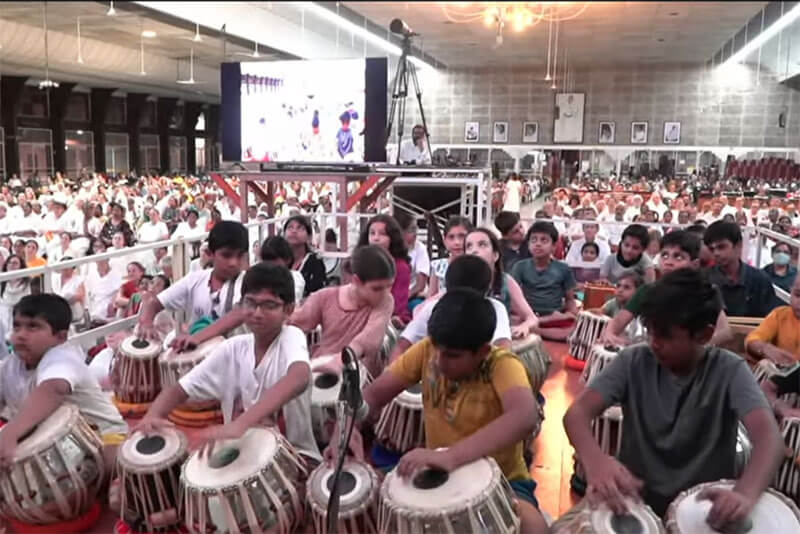
twenty or thirty children sitting with their tablas below the main stage on a small special stage right in front of amma. one or two leading. all the others following.
and among them you may find a tiny two- or three-year-old sitting seriously in front of a tabla! some times tabla is bigger than them. their hands cant reach the black and white portion of the tabla at the same time.
sometimes amma asks one child to play alone. the mic is placed before the tabla, and the whole ashram hears it. it is also shown live on the screens.
amma calls children by name and ask them to perform individually. she would even point out that a particular part, or the concluding part was not played correctly. she will ask them to replay it.
everyone watches in awe.
such tiny hands… such confidence!
and this has not stopped with children’s tabla sessions.
many of those who started learning are now becoming almost professional in their approach and performance.
today, you can see schoolchildren accompanying the bhajans of brahmacharis, brahmacharinis and other singers during amma’s darshan time.
the children even have their own bhajan sessions. they play harmonium. they play tabla. they sing. basically… they rock the hall!
amma even sending the kids group for bhajan programs outside, for big public functions at the colleges and temples!
over the years, during vijaya dashami, vishu, guru purnima there was a ‘nadarchana’ musical offering for amma in which all these 400 odd tabla players, a dozen harmonium, a dozen kaimani, plenty of singers and musicians with mridangam, cajon, violin, veena, flute, and bells… together performed for amma. they played different classical songs, varnams and bhajans. each performance lasted more than 45 to 60 minutes.
there is something much deeper behind all this.
every one of us carries some potential within. often, we ourselves don’t know it is there. someone has to see it. someone has to encourage it. someone has to give it the right atmosphere, nurture it and allow it to grow. that is what a guru does.
a guru does not merely give us teachings. the guru sees possibilities within us that perhaps we have never seen ourselves. the guru creates a conducive atmosphere where our good vasanas can sprout, grow, flower and finally become useful to others.
a three-year-old with a tabla today may become someone who brings joy to thousands tomorrow. who knows?
the potential was already there. it only needed someone to see it. someone to nurture it.
someone to say… “come, play.”