Here are some beautiful insights from the Valmiki Ramayana about the city of Ayodhya. you will be amazed to read about the city’s incredible design, engineering, and strength, along with the deep character of its people.
1. Origin and Location
- Prosperous Kingdom of Kosala: Ayodhya was the capital of the great and joyous Kosala country, situated on the banks of the Sarayu river, which was abundant in wealth and foodgrains.
- Constructed by Manu: The city was personally built by Manu, the patriarch of mankind.
कोसलॊ नाम मुदितः स्फीतॊ जनपदो महान् ।
निविष्टः सरयूतीरे प्रभूतधनधान्यवान् ॥
(There was a great and prosperous country named Kosala, full of joy, situated on the banks of the Sarayu river, and abundant in wealth and grain.) Verse 1.5.5
2. City Dimensions and Urban Layout
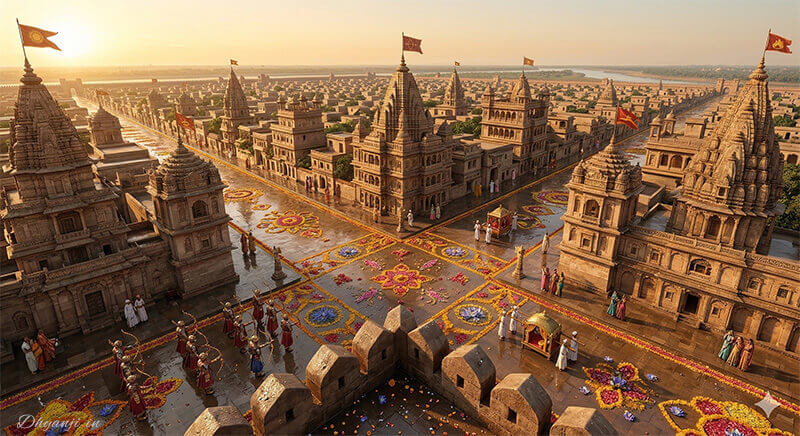
Ayodhya was a marvel of ancient urban planning with impressive proportions and meticulously maintained roads.
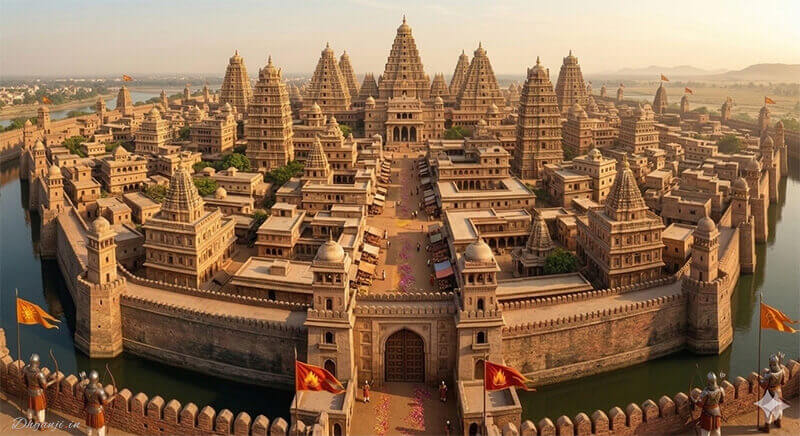
- Vast Dimensions: The great city extended twelve yojanas in length and three yojanas in width.
- Well-Laid Highways: It featured broad, well-divided royal highways that were continuously sprinkled with water to settle dust and strewn with fresh flowers.
- Grid Layout: The city was structured perfectly like an eight-sectioned grid (Ashtapada), constructed on leveled land leaving no space unutilized.
आयता दश च द्वे च योजनानि महापुरी ।
श्रीमती त्रीणि विस्तीर्णा सुविभक्तमहापथा ॥
(This great city was twelve yojanas long and three yojanas wide, glorious and prosperous, with well-divided grand roads.) Verse 1.5.7
3. Splendid Architecture and Infrastructure
The city’s skyline and infrastructure were breathtaking. The residential and royal infrastructure of Ayodhya was a testament to advanced civil engineering, strictly adhering to the principles of ancient architectural sciences.
- Grand Gateways & Edifices: It was fortified with arched outer gateways featuring sturdy panel doors, well-arranged inner markets, and tall watchtowers flying flags.
- Celestial Palaces: Studded with precious gems, the magnificent turreted mansions and multi-storied palaces made Ayodhya resemble Indra’s celestial city, Amaravati.
प्रासादै रत्नविकृतैः पर्वतैरुपशोभिताम् ।
कूटागारैश्च संपूर्णामिन्द्रस्येवामरावतीम् ॥
(Like Indra’s Amaravati, it was adorned by mountains and mansions modified with precious gems and complete with magnificent turreted mansions.) Verse 1.5.15
3.a. Hierarchical House Sizes and Master Artisans
The city’s construction was guided by the precise rules of town planning (Vastu Shastra) and executed by master craftsmen (Shilpa Shastra). The dwellings reflected a structured society, broadly categorized into three sizes: common houses (Gṛha), large turreted mansions of the nobles (Kūṭāgāra), and grand royal palaces (Prāsāda). The city was built on perfectly leveled ground, leaving no space unutilized.
कवाटतोरणवतीं सुविभक्तान्तरापणाम् ।
सर्वयन्त्रायुधवतीमुपेतां सर्वशिल्पिभिः ॥
(That city… possessing all types of machines and weapons, and inhabited by all kinds of artisans/master architects [sarvaśilpibhiḥ].) Verse 1.5.10
गृहगाढामविच्छिद्रां समभूमौ निवेशिताम् ।
(Its dwellings were constructed on leveled ground [samabhūmau niveśitām – a core Vastu principle] with no space left unutilized…)Verse 1.5.17
3.b. Multi-Storied Buildings and Seven-Storied Mansions
Ayodhya was not a flat city; it boasted an impressive skyline. The text explicitly mentions the presence of multi-storied buildings, specifically referring to magnificent seven-storied mansions that adorned the city grid.
चित्रामष्टापदाकारां नरनारीगणैर्युताम् ।
सर्वरत्नसमाकीर्णां विमानगृहशोभिताम् ॥
(With groups of men and women, designed like an eight-sectioned grid, it was rich in all kinds of gems and adorned with seven-storied palaces [vimānagṛha].) Verse 1.5.16
3.c The Grandeur of the “Vimana”
Valmiki repeatedly uses the term Vimāna to describe the awe-inspiring palaces and houses of the nobles. In the context of the Ramayana, Vimana denotes celestial, flying chariots of the gods, implying that the houses in Ayodhya were of such massive scale, symmetry, and divine beauty that they looked like they belonged in the heavens.
Furthermore, this exact terminology provides a direct link to traditional Hindu temple architecture, where the towering, multi-tiered, pyramidal structure built directly above the Garbha Griha (sanctum sanctorum) is known as the Vimana. The towering, stepped, and pyramidal nature of Ayodhya’s high-rises mirrored this sacred geometry.
विमानमिव सिद्धानां तपसाधिगतं दिवि ।
सुनिवेशितवेश्मान्तां नरोत्तमसमावृताम् ॥
(Like a celestial palace/aerial car [vimānam] of the perfected beings attained in heaven through their austerities, the palaces were perfectly constructed in rows and inhabited by the noblest of men.) Verse 1.5.19
4. Fortifications and Military Prowess
Ayodhya was an impenetrable fortress protected by elite warriors and formidable defenses. True to its name it was A-Yodhya, the unconquerable city.
- Impregnable Defenses: The city was surrounded by deep, formidable moats and massive fortifications, fully stocked with advanced weaponry, including Shataghnis.
- The Elite Warriors: The city was guarded by maharathas (great warriors) who were swift-handed archers with the rare skill of Shabdavedhi (striking targets purely by sound). They were like blazing fires, skilled and absolutely intolerant of enemies.
योधानामग्निकल्पानां पेशलानाममर्षिणाम् ।
संपूर्णाकृतविद्यानां गुहाकेसरिणामिव ॥
(Those warriors were like blazing fires, skillful, and intolerant of enemies, completely accomplished in all branches of knowledge, like lions in their caves.) Verse 1.6.19
5. The Animals of Ayodhya
5.a The Majestic Elephants
The elephant forces of Ayodhya were highly classified by their geographical origins, divine lineages, and specific temperamental or physical breeds.
- Geographical Origins: They were brought from the great Vindhya mountain ranges and the Himalayas.
- Divine Lineages: The text mentions elephants descended from legendary mythical ancestors, specifically Añjana and Vāmana (two of the celestial elephants that guard the cardinal directions).
- Breeds and Crossbreeds: Elephantology (Gaja Shastra) in ancient India classified elephants into primary types based on their physical characteristics and temperament. Ayodhya housed all three primary breeds and their crossbreeds:
- Bhadra: Auspicious, majestic, and well-proportioned.
- Mandra: Heavy-set, slow, and broad.
- Mriga: Slender, agile, and deer-like.
- Crossbreeds: Bhadramandra (Bhadra + Mandra), Bhadramriga (Bhadra + Mriga), and Mrigamandra (Mriga + Mandra).
विन्ध्यपर्वतजैर्मत्तैः पूर्णा हैमवतैरपि ।
मदान्वितैरतिबलैर्मातङ्गैः पर्वतोपमैः ॥
(And it was also filled with rutting elephants, originating from the Vindhya mountains and even from the Himalayas, all highly potent, extremely powerful, and resembling mountains in their stature.) Verse 1.6.21
अञ्जनादपि निष्क्रान्तैर्वामनादपि च द्विपैः ।
भद्रमन्द्रैर्भद्रमृगैर्मृगमन्द्रैश्च सा पुरी ॥
(That city was adorned with elephants descended from Añjana, and also with those from Vāmana, along with elephants of the Bhadra and Mandra types, Bhadramṛga types, and Mṛgamandra types.) Verse 1.6.22
5.b The Excellent Steeds
The cavalry and chariot forces of Ayodhya were powered by elite breeds of horses, specifically sourced from regions famous for breeding the finest war-horses.
- Geographical Breeds:Kamboja: From the Kamboja region (modern-day Central Asia/Afghanistan border).
- Bahlika: From the Bactria region (northern Afghanistan).
- Vanayu: From the Vanayu region (often associated with Arabia or Persia).
- Nadija: River-born horses (likely from regions along the Indus or other major river basins).
- Divine Comparison: These horses were of such high pedigree that they were compared to Harihaya, the divine horses of Lord Indra.
काम्बोजविषये जातैर्बाह्लीकैश्च हयोत्तमैः ।
वनायुजैर्नदीजैश्च पूर्णाहरिहयोपमैः ॥
(And the city was filled with excellent horses, originating from the Kamboja region and Bahlika, as well as those born in Vanayu and near rivers, all resembling the divine horses of Indra.) Verse 1.6.20
5.c Domesticated Livestock
Ayodhya’s economy, trade, and daily life were supported by a vast population of domesticated animals that kept the city thriving.
- Cattle (Go): Cows and bulls used for milk, agriculture, and religious rituals.
- Camels (Uṣṭra): Used as beasts of burden for trade routes and transport.
- Mules / Donkeys (Khara): Used for carrying heavy loads across the city and kingdom.
दुर्गगम्भीरपरिखां दुर्गामन्यैर्दुरासदाम् ।
वाजिवारणसंपूर्णां गोभिरुष्ट्रैः खरैस्तथा ॥
(It possessed deep, formidable moats, making it impregnable and difficult for others to approach. It was teeming with horses, elephants, as well as cows, camels, and donkeys.) Verse 1.5.13
5.d Wild Animals of the Surrounding Forests
While not domesticated within the city walls, the dense forests surrounding Ayodhya were teeming with fierce wildlife. These animals served as the ultimate test of skill for the city’s elite maharathas (warriors).
- Lions (Siṃha)
- Tigers (Vyāghra)
- Wild Boars (Varāha)
सिंहव्याघ्रवराहाणां मत्तानां नदतां वने ।
हन्तारो निशितैः शस्त्रैर्बलाद्बाहुबलैरपि ॥
(They were slayers of fierce lions, tigers, and boars roaring in the forest, killing them forcefully with sharp weapons and even with the strength of their own arms.) Verse 1.5.21
6. Governance and The Character of the People
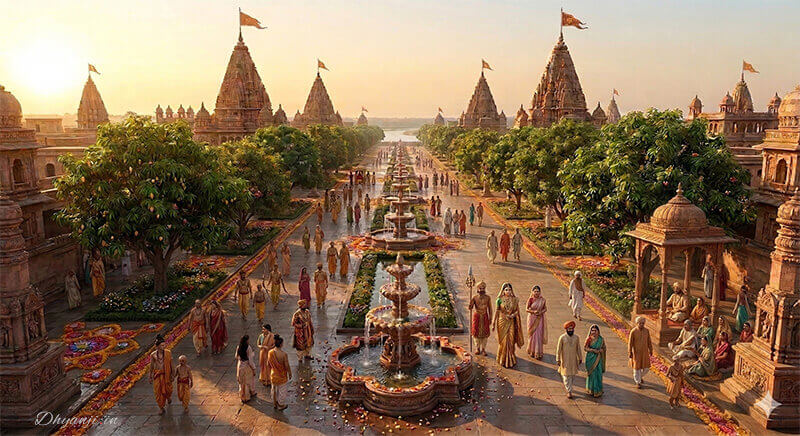
Under King Dasharatha’s rule, Ayodhya was a utopia of wealth, morality, and social harmony.
- Prosperity and Contentment: There was no household with meager savings; every family was successful and wealthy in cattle, horses, and grain. Everyone wore fine ornaments, bathed regularly, and used pleasant fragrances.
- Moral Excellence: The citizens were highly educated, truthful, and deeply righteous. It was impossible to find anyone in Ayodhya who was lustful, stingy, cruel, unlearned, or atheistic (nāstika).
- Social Harmony and Duty: The society functioned in perfect harmony. The Brahmins were dedicated to their duties, self-controlled, and devoted to charity and study. Everyone was devoted to the king, resulting in a city completely devoid of miserable, agitated, or distressed individuals.
तस्मिन्पुरवरे हृष्टा धर्मात्मना बहुश्रुताः ।
नरास्तुष्टाधनैः स्वैः स्वैरलुब्धाः सत्यवादिनः ॥
(In that excellent city, the men were joyful, righteous-souled, and highly educated. They were contented with their own respective wealth, not greedy, and truthful.) Verse 1.6.6
कामी वा न कदर्यो वा नृशंसः पुरुषः क्व चित् ।
द्रष्टुं शक्यमयोध्यायां नाविद्वान्न च नास्तिकः ॥
(In Ayodhya, it was impossible to find any person who was lustful, stingy, or cruel; nor one who was unlearned, nor an atheist.) Verse 1.6.8
7. Ayodhya City in Mourning
The vibrant, prosperous city transformed completely into a landscape of grief and lifelessness when Rama departed for his exile. This shows another picture of the city and of people’s mind set.
- Lifeless Streets and Markets: The joy of the city vanished. Merchants stopped selling their wares, the bustling marketplaces looked completely lifeless and graceless, and householders did not even light fires to cook food.
- Loss of Joy in Wealth and Family: The acquisition of vast wealth or even the birth of a firstborn son brought no joy to the citizens. They felt that houses, wealth, and family had no purpose if they could not see Rama.
न चाहृष्यन् नचामोदन् वणिजो न प्रसारयन्।
न चाशोभन्त पण्यानि नापचन् गृहमेधिनः।।
(The people had no joy in life… The merchants did not offer their wares for sale. The marketplace looked graceless. The householders did not cook their food.) Verse 2.48.4
नष्टं दृष्ट्वा नाभ्यनन्दन् विपुलं वा धनागमम्।
पुत्रं प्रथमजं लब्ध्वा जननी नाभ्यनन्दत।।
(Neither loss nor acquisition of wealth mattered… No mother rejoiced over getting her firstborn son.) Verse 2.48.5
किं नु तेषां गृहैः कार्यं किं दारै: किं धनेन वा।
पुत्रैर्वा किं सुखैर्वापि ये न पश्यन्ति राघवम्।।
(For those who do not see Rama, of what use are the houses or spouses or sons or fortunes or delight?) Verse 2.48.7
8. Supreme Governance and Righteous Rule
Upon taking the throne, Rama established a rule deeply rooted in dharma. with righteousness as his very nature, he governed alongside his brothers and friends. His reign was defined by profound spiritual dedication, absolute justice, and great vedic rituals performed for the welfare of the world. This ultimate era of perfect governance, joy, and prosperity under lord rama is what we call Rama Rajya.
8.a Absolute Security, Health, and Absence of Grief
Under Rama’s protection, the physical and emotional vulnerabilities of human life were practically eliminated. The kingdom experienced unprecedented peace and health.
- No Fear or Disease: Citizens were completely free from the fear of wild beasts, and no one suffered from any diseases.
- Eradication of Sorrow and Premature Death: There were no lamenting widows. The natural order of life was perfectly maintained; there was no premature death, meaning elderly parents never had to perform funeral rites for their children.
न पर्यदेवन् विधवा न च व्यालकृतं भयम् ।
न व्याधिजं भयं वापि रामे राज्यं प्रशासति ॥
(During Rāma’s rule over the kingdom, widows did not lament, there was no fear caused by wild animals, nor was there any fear arising from disease.) Verse 6.116.84
निर्दस्युरभवल् लोको नानर्थः कं चिदस्पृशत् ।
न च स्म वृद्धा बालानां प्रेतकार्याणि कुर्वते ॥
(The world became free of bandits. No misfortune afflicted anyone. Nor did elders perform the funeral rites for their children, indicating that children did not die before their parents.) Verse 6.116.85
8.b Social Harmony and High Moral Character
The character of the people reached its absolute peak, reflecting the virtues of their king.
- Devotion to Dharma: Everyone was completely joyful and solely dedicated to Dharma (natural law and righteousness).
- Mutual Respect and Non-Violence: Constantly looking up to Rama as their ultimate role model, the citizens lived in perfect harmony and never harbored ill will or caused harm to one another.
सर्वं मुदितमेवासीत् सर्वो धर्मपरो ऽभवत् ।
राममेवानुपश्यन्तो नाभ्यहिंसन्परस्परम् ॥
(Everything was indeed joyful. Everyone became solely dedicated to natural law (dharma). Always looking to Rama alone, they did not harm each other.) Verse 6.116.86
8.c Immense Longevity and Prosperity
The blessings of Rama Rajya extended not just to the quality of life, but its quantity and the surrounding environment.
- Long and Fulfilling Lives: The people lived healthy, sickness-free lives spanning thousands of years, surrounded by large, joyful families and free of any sorrow.
आसन् वर्षसहस्राणि तथा पुत्रसहस्रिणः ।
निरामया विशोकाश्च रामे राज्यं प्रशासति ॥
(When Rama was administering the kingdom, people lived for thousands of years, and they were free from sickness and sorrow, having thousands of sons.) Verse 6.116.87
8.d Harmony with Nature
The perfection of human society directly influenced nature, resulting in ecological perfection and agricultural abundance.
- Abundant Nature: Trees were eternally blossoming and bearing fruit, with broad, flourishing branches.
- Perfect Weather: The climate was perfectly balanced—rains always fell exactly at the proper agricultural times, and the winds were always gentle and pleasant to the touch.
नित्यपुष्पा नित्यफलास्तरवः स्कन्धविस्तृताः ।
कालवर्षी च पर्जन्यः सुखस्पर्शश्च मारुतः ॥
(The trees always blossomed and bore fruit, their branches spread wide. The rain cloud rained at the proper time, and the wind was pleasant to the touch.) Verse 6.116.88
Jai Sri Ram